Faith, Madness, and Spontaneous Human Combustion: What Immunology Can Teach Us About Self-Perception
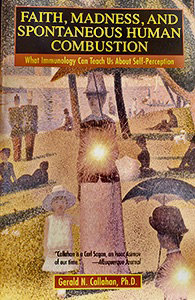
Personal, poetic, and anchored by research, Faith, Madness, and Spontaneous Human Combustion: What Immunology Can Teach Us About Self-Perception is a provocative look at the startling ways in which modern science shapes our identities. In this book, scientist and poet Gerald N. Callahan reveals what science has uncovered, sometimes unwittingly, about us: where we begin, how we grow, why we die, and what comes afterward.
The immunologist author dissects the immune system to reveal its most intimate underpinnings: the selves hidden inside our thymuses, the pieces of others lodged in our lymph nodes, the gift of human death, and the fires that burn inside our bodies. From the seemingly sterile voice of science come the words that define each of us. We are singular men and women only because we have immune systems, and when they fail, people disappear; in their places, communities of living things arise. Buried inside our genes and our lymphocytes science has found faith and love, madness, and the fierceness of human beings.

The living room was marked in an odd way. None of the furniture, other than the chair and the end table next to it, was badly burned. But the ceiling, draperies, and walls—from a point four feet above the floor—were covered with an oily yellow soot. Below four feet, the walls looked untouched. And when the investigating lieutenant cleared away the last of the ashes, the carpeting below where Mary had died was only superficially charred. On the adjacent wall, ten feet away, a mirror had cracked; and on the opposite wall, twelve feet or more from the body, two pink candles had puddled in their holders, but their wicks were intact. Four feet above the floor, the wall outlets had melted, but none of the fuses had blown. And the outlets in the baseboard appeared untouched.