Almost Like Dancing
I am circling around god, around the ancient tower, and I have been circling for a thousand years and I still do not know if I am a falcon or a storm or a great song.
—Rainer Maria Rilke
I only do it with birds. I’m not sure why. Maybe it’s that birds are the most nearly perfect things I know. Or maybe it’s because birds are things I’m not—graceful, self-reliant, certain. It makes no difference. And I’d like to tell you I’m proud of what I do. I’m not. I just can’t help myself.
I can’t, anymore, leave birds—especially birds of prey—crumpled like Coors cans in the middle of a greasy highway.
So this morning, on my way toward Moab, at about seventy-five miles per hour, an owl—a big owl—face down in the far left lane, snares me. “Leave it lie,” someone inside of me says. “It's the freeway for God’s sake, and who knows when you’ll get a chance to turn around again. Besides, it’s dead!” But someone else inside has already moved the truck into the left lane, turned on the flashers, and started looking for a place to cross over. I find the next crossover only a couple of miles back.
And then I’m out of the truck, standing on the gritty shoulder of westbound I-70, a breeze full of river water searching in the bunchgrass. It’s a great horned owl, the biggest one I’ve seen. And because even its eyes haven’t yet been worked over by the magpies and ravens, it hasn’t been dead for long. I nudge him with the toe of my right boot, not caring to go finger-first after an owl only partially dead. He doesn’t move. I turn him over onto his back. Only once before have I had the opportunity to look at a big great-horned up close, and that one was already full of maggots. This one is like new. No blood, no broken feathers, no obvious injury at all. Good as the day God made him—except, of course, he’s dead.
Dead or alive, though, this is a remarkable machine. One polished over millions of years by the steady hand of evolution, honed, near perfectly, for the sole purpose of killing. And by the size of this guy, he must have been pretty damned good at it. Toes tipped with hooks, big as my fingers—shining, this morning, like fire-polished onyx. A wrinkled palm, almost human—leathery, punctate, skin the color of hunger and death. And square in the center of his serious face a jet black beak, big as half my fist—a goblet for skin and scale, for flesh and bone. Covered over with feathers—like a blizzard of chocolate and sienna, cinnamon and teak, ivory and sea salt, moonlight and sunrise—no two alike. I spread one stiff wing to its full length—nearly a yard.
I imagine the owl in flight—slow hushed arcs beneath the darkness, eyes full of torchlight. I imagine the terror of shadowed field mice and cottontails, collared lizards, red racers, freshly born coyotes. I imagine a mouthful of warm blood and the sweet pop of gristle.
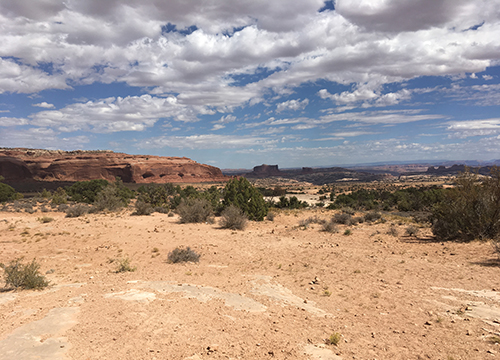
It’s a good morning to still be breathing. I lift the bird into my arms and climb the near embankment. Above the roadway the land opens out to a warm sea of sage and pygmy juniper. Magpies are reading their morning matins, and in the distance the dark canyon of the Colorado splits the low ridge of the horizon. I walk for thirty yards or so, toward a low, thick-limbed juniper tree. The bird is heavy and warm in my arms. The other owl—the one full of maggots—weighed nothing, felt like an armload of winter evening. This bird has the heft of summer.
I lay the owl beneath the tree and prop its head so it faces southeast—where the sun will rise tomorrow. And then, I pull three of his primary flight feathers—long as my forearm—from the end of his left wing and slip them inside my shirt. It is essential. I try to think of something to say, a prayer maybe, something to say out loud. Nothing comes. I wish the owl good hunting and Godspeed.
I walk back to my car. The sun’s breath is warm and dry against the skin of my neck, on the backs of my arms. My heart pulses steadily within its sheath. The sky is fat with promise.
Quickly, the pavement is again rattling by underfoot. Again, an odd sense of remorse has settled inside me. And again, I have Interstate 70 mostly to myself. I draw one breath, then another, and then one more. Twenty miles later I’ve nearly forgotten the owl. Instead of hooks and beaks and bones like flutes, my mind is filled up with old fears and budding uncertainties.
About five years ago something happened, something big. A star in Cassiopeia collapsed, or didn’t, as it should have; a flower failed to bloom, or blossomed a string of passionate red petals; a stone, pushed by spring floods, left the spot where it had rested for 3,000 years, or didn’t; a river leaped from its bed or failed to—something big. And at that moment, everything, I mean everything, changed. Five or so years ago that happened. I hardly noticed then. But I can’t ignore the evidence any longer.
I’ve been a biologist most of my life—specifically, an immunologist, but I like the term biologist better. Maybe because it doesn’t seem so closely linked to human medicine, maybe not. Maybe it just sounds earthier. But from about the time I was twelve, a biologist was what I wanted to be. I still want, sometimes desperately, to be a biologist, I’m just not certain anymore what that means.
And it’s not that I’m leaving science, exactly. No, it’s a whole lot more like science is leaving me—more like the universe one day just said, “That’s enough of that shit.” And biology, having never been particularly pleased with the job I was doing anyway, slipped out the side door.
Off the road to the right a golden eagle is hanging in a morning thermal, watching the land below—waiting, almost indifferently, for a single lapse, an instant of forgetfulness, a moment of courage. And the eagle knows—no matter how many times before everybody noticed him, no matter how many times before no one mistook him for a cloud or a raven or a swarm of bees—there will be mistakes, soon. The eagle waits, in the shaft of sun-warmed air, and circles.
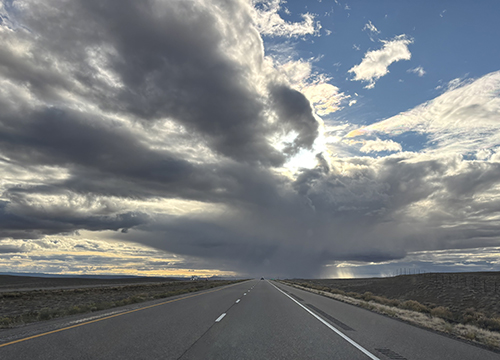
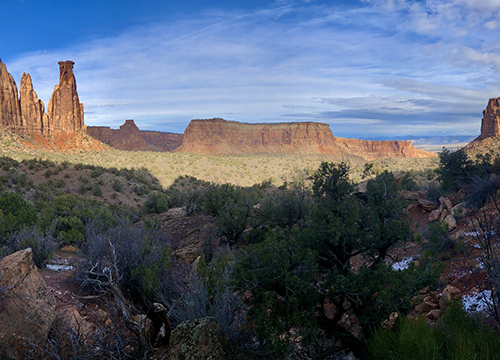
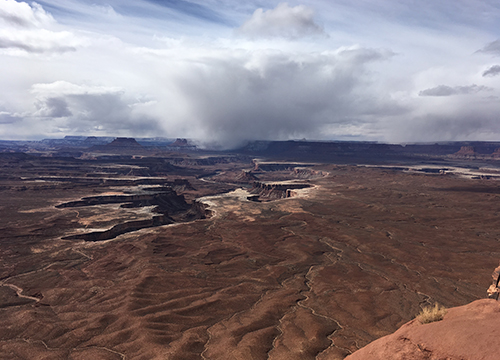
This section of I-70—after you’ve left the cities and the river behind and climbed up onto the eastern edge of the Colorado Plateau—to the extent twin ribbons of concrete can, soothes me. The Manti La Sal, snowcapped this January, pierce the sky to the south, tattered old turbans still clinging to their heads this morning. The north is rimmed by the Book Cliffs, laid out here like some new attorney’s collection of The Law Review. All else is sagebrush and sand punctured by an occasional juniper, but otherwise unmarked, in large part, by man or beast. And of course, there is sky—lots and lots of sky.
Biology taught me my first serious way of looking at things, a deep way. A little like the way the first older woman or man you sleep with shows you how something you’ve hardly even noticed for most of your life can give you unimagined pleasure when touched very softly, when squeezed a little too hard, or when brushed by human lips. And that’s probably good. But after an experience like that it’s easy to become obsessed and try to build walls around things, try to isolate a thing—tear it down, build it up, come to know it apart from every other thing in the universe. And then there comes that time in the middle of the night when you wonder, no matter how you try to suppress it, wonder—just for a instant—if it’s enough; wonder if maybe you’re cheating yourself somehow. Or at least I did. And that’s all science was waiting for, that’s when science tossed her ring on the bed and stepped out the door.
Now, I don’t think she’s coming back, and in the 3:00 A.M. darkness of winter mornings, that sometimes scares me.
The turnoff to Cisco interrupts my thinking. Good. I pull to the right, loop south under the freeway, then head west on a narrow little road that ultimately leads to Cisco, Utah. That’s a lie, of course—all roads, like rivers, ultimately lead to the sea. But in this neck of the woods this road’s primary purpose is to transport people from points east into the Cisco metroplex—in the middle of nothing but sagebrush and, for no apparent reason, a collection of ten or fifteen wooden buildings in various states of disrepair and habitation. Some are posted with sternly worded signs that read redly NO TRESPASSING! I can’t imagine why anyone would trespass here anyway—in one of these ramshackle wooden buildings, likely full of kangaroo rats and garter snakes, black widows, scorpions, and bats—in the midst of more public land than you or I can even imagine, and every square meter of it just begging for a footfall. But Moab attracts a different kind of crowd these days, and much of that crowd, evidently too much, gets to Moab via Cisco. So who knows.
Before those signs went up I thought this would be a nearly ideal place to live. Middle of nowhere—no telephones, shopping malls, stoplights, school boards, or chambers of commerce. That may have changed. Seems unlikely these men and women would go to the trouble of putting up signs without cause.
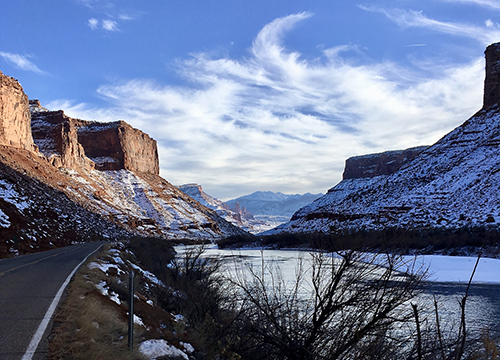
A quick left and I’m on the road to Moab. The road from Cisco to Moab is a fine one, full of odd twists and turns, narrow spots, overhangs, washouts, abrupt ups, sudden downs, unexpected lefts, unanticipated rights, and lots of river. The powers that be will probably widen and straighten it any day now. For the moment, I just drive as fast as I can, honk my horn a lot, and imagine how it would be to end my life in this here river.
The road winds past some truly unbelievable places—Dewey—with its inspirational messages, Proudfoot Bend, the Fisher Towers, the Professor Valley. At the end, though, the road just settles into a slow waltz with river and winds through a deep trench of Entrada and Navajo sandstone—twin spirals of petrified earth, their dark red reflection bleeding into the green riffles of the Colorado River. Easier to see here how the river got its name. A wonderful spot. Then, all too abruptly, you’re spit out onto State Highway 163, down from Crescent Junction. Sic transit gloria mundi.
I hang a right and pick up the road toward Crescent Junction. Only briefly though—a quick left and I’m onto the Potash Road. There’s a little canyon up here I noticed on an earlier trip, and today I’m going back to see if I can find a way in—and out, of course. That’s important too.
Past the Moab slough and beyond red-rock walls bristling with bolt ladders, about twenty minutes down the road I locate the spot I’m looking for—a little neck of stone, a bend in the road. I pull off to park. Rain and maybe snow were in the forecast I caught on the radio this morning. But this December day appears to have something else in mind. It’s a bit overcast, true. But according to the little thermometer on my pack it’s nearly fifty-five, and my feet are anxious for sandstone. I change into my boots, stow the keys under the seat, and fill my water bottle.
As a mixture of Cache la Poudre and Colorado River water trickles into my bottle, I can’t help but think how glad I am to be here. The air smells of river and stone, of blue sky and wet willows. My skin feels like someone else’s. And I just know something remarkable is about to happen. Not because of omens or auguries, though there’ve been plenty. I just know this place. Something is always happening.
Much of my time in science was spent trying to make something happen—animals get sick or better, data fit or not my preconceptions, nucleic acids rearrange or not. It isn’t like that here. I never know what’s coming, true. But I know for sure something is already in the pipeline. I just know it. I know, too, that it’s for me and me alone, for certain, every time. I shudder—a victim’s spasm of anticipation—shoulder my pack, and head out.
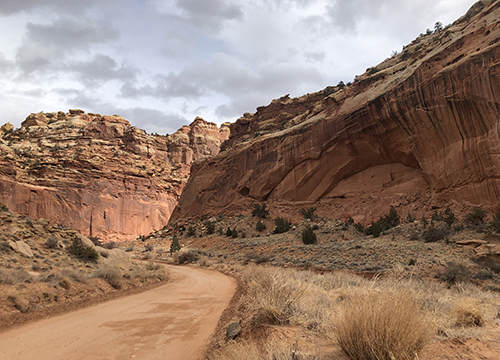
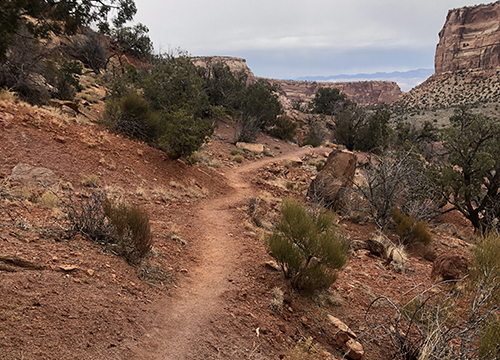
The trip in goes up a little wash that quickly spirals into a cleft between two high walls of Entrada sandstone. The bottom of the cleft is filled with deep red sand. Delightful to look at, a pain in the ass to walk in. Walking in sand is almost like dancing—almost, that is, like waltzing, waltzing with someone you don't much care for to the music of a band that only knows tangos. As soon as I can I work my way up onto a shelf on the west wall and traverse past dry falls. The canyon widens then, opens out to a broad stone hogback littered with black rocks—about twice the size of my fist—pockets of sand, and a handful of mint-green junipers. I stop for water.
The sky’s a cirrus custard, and there’s a little breeze blowing up from the river. You can smell the water, and something else—something perhaps not as old as water, but near as old as these rocks. It is a fine day, I mean a fine goddamn day, for a walk.
Across from where I sit (two canyons away actually, a thing I will learn later) there’s an enormous jug-handle arch. Hard to say from this distance, but the arch must be a couple hundred feet high and forty feet thick. The sort of handle that you might find on Thor’s jug of mead or Godzilla’s jug of fire-breath fuel. I think of water shaving away at that sandstone, trickling in in September, blowing its hydraulic jacks in January, then pulling up stakes and slipping away in the springtime—year after year. One precious millimeter at a time. Water is a powerful mentor.
I shoulder my pack again and head off toward the rim of the near canyon. Between here and the stone ledges above the canyon there’s a minefield of cryptogams, little mixtures of algae, fungi, mosses, lichens and what have you, that set the stony soil up for the entrance of bigger things—grasses, trees, and Howard Johnsons, for example. Without them, what little soil there is up here just blows away. Because it takes about a hundred years for these little guys to become sufficiently established to hold back a tablespoonful of soil, it seems . . . insensitive to crush them underfoot simply because they lie between me and my goal. So I try to avoid them. Walking in sand may be a little like a waltz to tango music, but walking across cryptobiotic soil is a lot more like trying to dance a samba to polka music. Hard to find a good rhythm. From a distance I imagine my gait must look like I’ve some sort of neurodegenerative disorder. Like there's something not wired quite right, or soldered securely, between spine and brain. Which is true, of course, but not the reason for my stride.
Finally, I’m out onto sandstone again. Here, the Entrada formation rolls over toward the canyon like the crust on a loaf of rock bread, then the sandstone gives up any pretense of horizontal and drops straight into the canyon below—fifty or a hundred feet. I drop my pack. When I was here before I never could find a route into this canyon that looked any better than the one in front of me.
I rig a rappel anchor, then uncoil my rope and toss it into the canyon. I clip the rope to the anchor, pull on my harness, and work my way down the vertical stone wall into the canyon.
Rappelling always makes me mildly sick to my stomach. No matter what my mind is doing, my ass knows that it should not be in the lead when together we are about to step off a cliff. My ass knows this is wrong, deeply wrong, and it reminds me of that. But my mind is attentively occupied elsewhere—noticing each of the grains in the sandstone, its size and texture; noticing the scrub juniper, seemingly growing out of solid rock; feeling each of the movements of my legs, the pressure of the harness, the heat of the rope slipping through my hands, my anal sphincter, the grate of my boots against the rock, the wind across my face; and underneath it all, the odd sense that I might—for no reason at all—just let go. But once again, I don’t.
And then I’m down.
Maybe awareness is the answer, the answer to the riddle of life, that is. Untarnished awareness.
Because at this point I’m not sure there’s another way out of this canyon, I leave the rope in place, stow my gear, and start up-canyon. This canyon is remarkably water-rich, especially for December—willows and tamarisk, reeds and junipers, and a thin stream of windowpane-clear water grinding at the stones and curling its way to the sea. Again I feel the Artist’s brush along my arms and up my spine. A fine day, a truly fine day.
As it rises, the canyon cuts more deeply into the stone, now five hundred, maybe a thousand feet below the sky-capped rim. Huge red slabs, streaked with black, rise like Lazarus, spattered with water and maidenhair fern, dry and gray this winter.
A raven screams somewhere.
I cross the stream for the last time, and I notice two sets of prints in the sandy soil—one deer, one human. So there is another way into the canyon. The human might have come in as I did, but I doubt that person carried the deer in on his or her back. So I suspect the bottom end of this canyon can be breached. And though both sets of tracks are old, they annoy me. I mean, after all the trouble I’ve gone to, I still have to share this canyon with the image of another human being. The clouds thicken a little, the wind blows a little colder, and my left foot begins to throb slightly in my boot as I work my way through the undergrowth toward the upper end of the canyon. Why can’t other people leave well enough alone, dammit? I think of turning back.
But only a mile or so farther the canyon comes to a dead end a thousand feet below the earth’s surface in an alcove of vertical stone. There’s a pool, and more maidenhair fern—but unlike those lower down, many of the ferns here are green, hard into December. It’s been months since I’ve seen anything but browns and grays at home. This verdant green rolls around inside my eyes like pearls on an oyster’s tongue, and inside my eyes this color of a faraway spring stirs something deep down and very old.
I unshoulder my pack and sit. A long sigh slips from my mouth. Above me the stone rises thirty feet, underhung, thick with ferns, then ledges off, back to the real wall. There the sandstone spires vertically to a frosting of dark caprock, and then to the sky, a sky you can hardly even imagine from so far below. And at the center of it all the pool, black-green, rippled by the wind—deep water that tugs at my eyes and strains my imagination.
I wish Gina were here. She has been as long as I without green. But it is different for her. At times, for her, being without green is like being without air, without sight, without the touch of a human hand. To bridge the brown ditch between autumn and spring, she fills the sills of our winter kitchen with colored bottles sprouting paper-whites and clay crocks with amaryllis rising to crimson spears. And that sustains her, but only just, until we plant pepper and tomato seeds in February and fill the bedrooms with fresh green sprouts. She would like these December ferns, she would like them in her eyes.
Knowing things. Knowing things that no one else has ever known. That’s what science was for me. Even a little thing—the location of a bit of sugar along the spiraled shaft of an important protein—known only to you sets you apart, apart from all who came before you, apart from all who surround you. Knowledge, and the power to create it. That’s a calling. Hell, that’s a sacrament.
But what about the rest of it? What about the power to see what all the others have seen, and to know in that instant what they knew? What about the power to remember—to hold in your cup knowledge deep as these rocks, and to recall who we have been? What about that?
Overhead, the sky has cleared and sunlight is seeping through. Shafts of light work the ripples in the pond. Bits of blue appear in the shredded fabric above. I wonder how long this pond has lain here. A million years, 10 million years? I wonder how these ferns can be this green, deep into this December.
As I sit, the sun on my back, the water at my feet, a snake of contentment uncoils inside of me—an odd sense that, for this moment, it doesn’t matter, any of it. I lie there, an hour, maybe an hour and a half, listening to the clouds slide past, to the wind in the pond, the steady seep of dark water through slits and notches in the ancient stone. Then it slithers out again, the snake—back into the red soil, the malachite-green water, the sunbaked, brick-colored walls. I reach for it, but it’s gone.
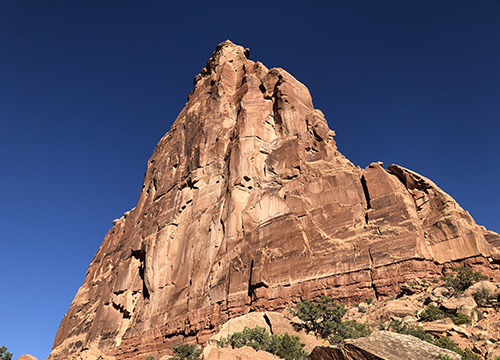
I stretch and rise to leave.
I think then to give something to the pond. Something in return. But I’ve left the owl’s feathers in the truck, and I have nothing else today, nothing a pond would want anyway, nothing of mine that would interest old water.
I think of the stones in the bag hanging on my pack, I pull out a pebble of basalt, a smooth black fingernail-sized chunk I’ve carried for a long time, and I toss it into the pond. There’s a satisfying sploop of water, and then the pebble is gone. Ripples move out in widening arcs until they strike the pond’s banks, reflect back on themselves, and slowly die. I start down-canyon.
On the way in I noticed no other exit from this canyon. And though, as I said, there must be one, I head instead for my rope. I intend to drive to Blanding this afternoon, and the light is beginning to fade. I find my rope where I left it, a thing that always relieves me. You wouldn’t think anyone would move a rope left like this one, but people do the damnedest things.
However, because I hadn’t anticipated using it to get back out of here, there’s another dance I have to do to “rescue” myself. I tie the bottom of one end of the rope to a stout little juniper. Then I slip into my harness and tie on my ascender. I clip onto the rope, work my way up the cliff face, over the edge, and onto the top. There, I tie a quick figure-eight knot into the doubled rope at the top, clip it back into the rappel anchor, slip the doubled rope into my descender, and rappel down again. At the bottom for the third time, I untie the end of the rope from the juniper, clip into my ascender, and climb the sandstone face once more. Saved, I sit for a drink of water and a breath or two.
But I don’t really think the secret of life is locked up somewhere inside of knowing something no one else has ever known, or even inside the sacred crate of common knowledge, not really. Maybe it’s buried instead among the things, like this rope, that tie us to all the rest of it. Things that bind it all into a single thing—one fact, a solitary process, a lone event—the sagebrush beside me, the juniper that held me, the sky that warmed me, the stone I’m sitting on, the view just beyond the next hill, and the fibers that run between them all.
And maybe that ain’t it either.
But I don’t think science offers any deeper insights than poetry. And that’s probably why science packed her bags. Equivocation can sometimes lessen a lady’s enthusiasm for an obsessive-compulsive lover like me.
Regardless, it’s a hell of day for a walk. I coil and stow my rope, my harness, the hardware. I shoulder my pack and start back toward the lower canyon. As I’m walking, for no reason I can imagine, I recall a baseball game—St. Olaf’s versus St. Patrick’s, Catholic Youth Organization league championship. I struck out twelve batters that day. We still lost, of course. But I was brilliant!
The breeze is at my back now.